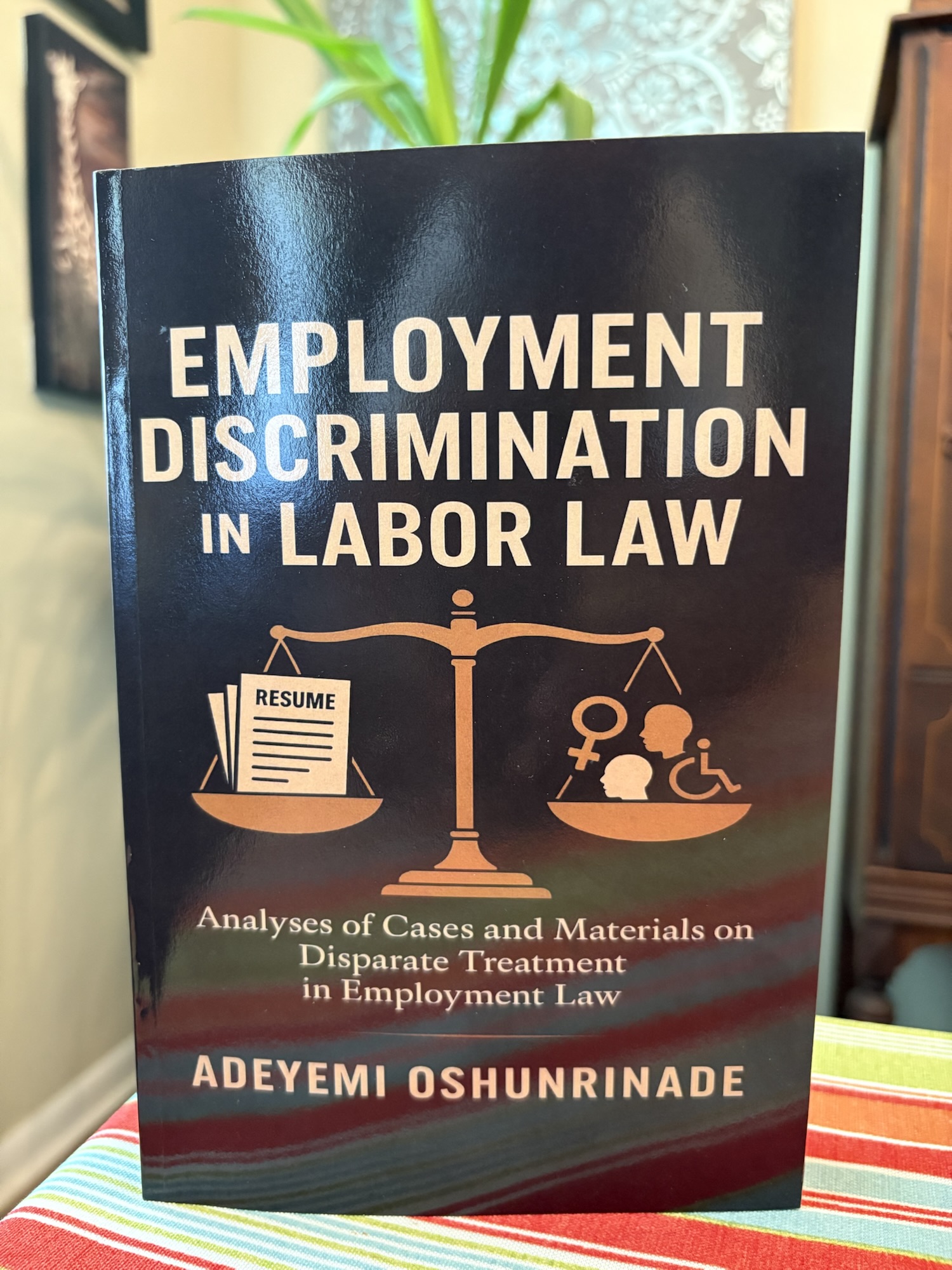
Analyses of Cases and Materials on Disparate Treatment in Employment Law
Adeyemi Oshunrinade
September 9, 2025
In the labyrinth of workplaces, where dreams and livelihoods converge, every person strives to realize the goal of economic stability. Yet, there exists an unsettling truth in the shadows—a truth that persists despite the teachings of equal treatment. This truth is the harsh reality of disparate treatment in employment discrimination, highlighting the challenges of achieving true workplace equity.
Employment Discrimination in Labor Law offers an in-depth analysis of employment discrimination, with an emphasis on disparate treatment within the workplace. This publication examines the historical context, foundational legal principles, and relevant case studies that inform contemporary perspectives on employment law.
As members of society seek personal fulfillment and aspire to a just social order, they rely on the legal system and its established laws to uphold principles such as equity, meritocracy, and individual rights. Nevertheless, there are occasions when these ideals are not fully realized; when biases persist and the promise of equal opportunity is not accessible to all. This book aims to systematically examine the ongoing and often subtle forms of unfair treatment within employment contexts, with the goal of bringing these issues to light and facilitating effective solutions.
The Introduction addresses the ongoing challenge of unequal treatment within employment law, underscoring its prevalence despite established standards of equality. It stresses the significance of upholding equity, meritocracy, and individual rights by adhering to relevant laws and regulations.
The Historical Perspective on Employment Discrimination chapter outlines the development of employment discrimination laws, highlighting major legislative measures such as Executive Order 8802 issued by President Franklin D. Roosevelt and the Civil Rights Act of 1964. It examines the establishment and function of the Equal Employment Opportunity Commission (EEOC) and reviews key amendments to Title VII that have influenced the legal framework governing employment practices.
Chapter One discusses Title VII of the Civil Rights Act (1964), which prohibits employment discrimination on the basis of race, color, religion, and national origin. The chapter outlines major provisions, such as the prohibition of sexual harassment and the requirement that Title VII applies to employers with 15 or more employees. It also presents case studies, including Johnson v. Alternatives Inc., which examines subject matter jurisdiction under Title VII.
Chapter Two presents an in-depth analysis of the concept of discrimination, offering a clear definition and examining multiple types of disparate treatment, including those based on race and gender. This chapter also reviews influential cases such as Texas Department of Community Affairs v. Burdine, which established the burden-shifting framework for adjudicating employment discrimination claims under Title VII.
Chapter Three examines Other Categories of Disparate Treatment, with particular emphasis on age-based discrimination as outlined in the Age Discrimination in Employment Act (ADEA). The chapter discusses landmark cases, including Gross v. FBL Financial Services, Inc., which clarified the burden of proof required in ADEA claims.
Chapter Four provides an analysis of Religion in Employment Discrimination, focusing on the obligation to accommodate religious practices under Title VII. The discussion references key cases, including EEOC v. Abercrombie & Fitch Stores, Inc., which explored employers’ responsibilities regarding religious attire, and Trans World Airlines, Inc. v. Hardison, which touched on the boundaries of the duty to accommodate religious observances.
Chapter Five gives an overview of National Origin, examining the implications of national origin discrimination within the workplace. The chapter features accent-based discrimination and analysis of the case Espinoza v. Farah Mfg. Co., that considered whether Title VII’s ban on discrimination based on national origin extends to discrimination related to immigration status.
The textbook presents comprehensive analyses of judicial decisions, legislative developments, and discussions on the psychological impact of employment discrimination. It is designed as a valuable reference for law students, attorneys, educators, and individuals interested in promoting assessment based on skills, character, and potential rather than immutable traits. Each chapter, from one through fourteen, concludes with both essay questions and multiple-choice assessments at the end to reinforce key concepts addressed within the book.
Adeyemi Oshunrinade is the author of “Medical Malpractice in Health Law.” He also wrote “Wills Law and Contests,” “Constitutional Law-First Amendment” and other publications available at Harvard books Barnes & Noble and Amazon Follow on Twitter @san0670.
Categories: Academic Journal, Labor Law, LAW, Race-Relations and Discrimination, Sexual Orientation


Leave a Reply