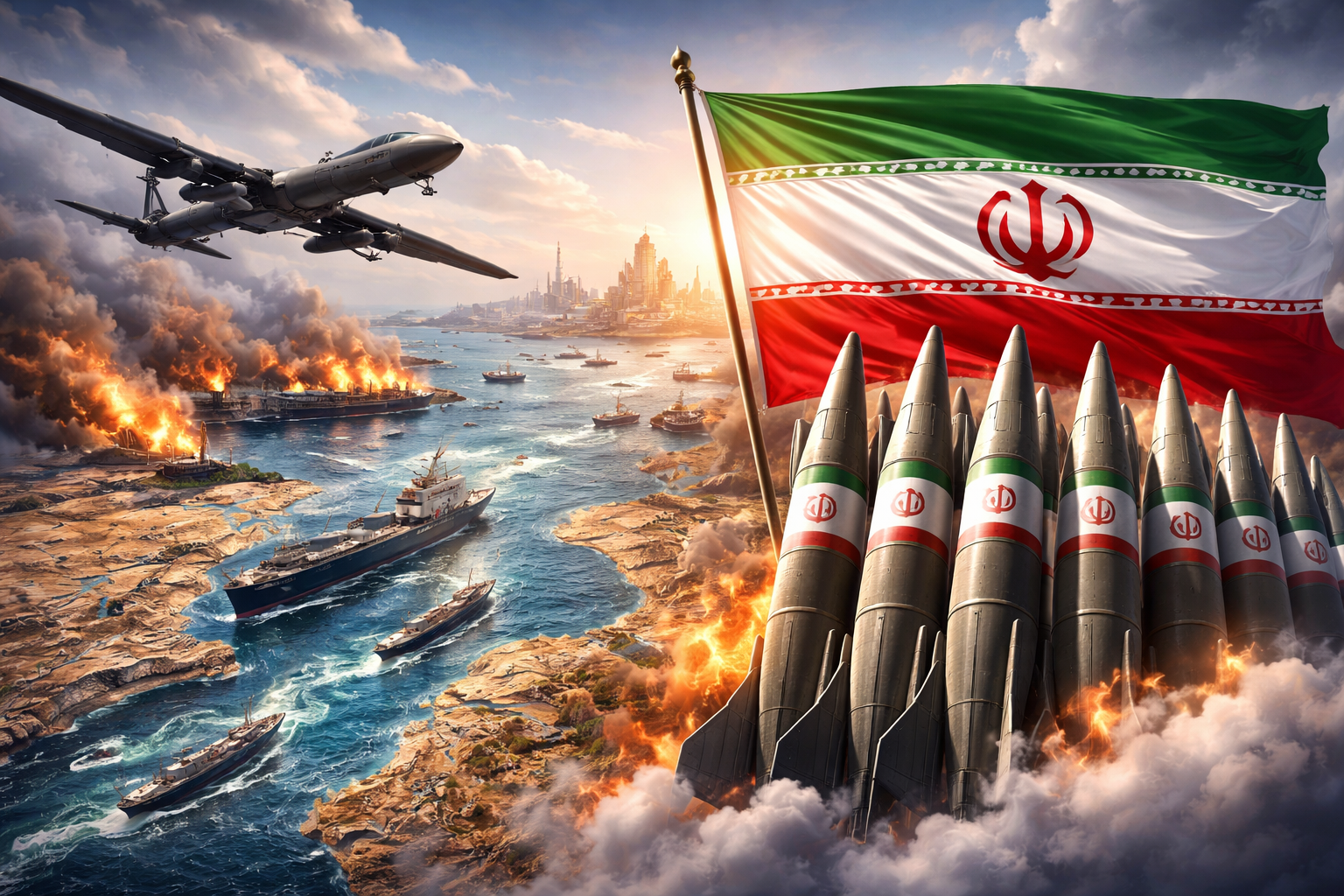
Iran’s strategic reach where control of the Strait of Hormuz, advanced missile and drone capabilities, and regional influence converge to shape global economy without reliance on nuclear weapons.
Adeyemi Oshunrinade
April 10, 2026
On February 28, when the United States and Israel launched their initial airstrikes against Iran, neither country anticipated that their actions would ultimately strengthen Iran’s position. The contemporary strategic posture of Iran and the response, reflect a critical calibration of power in the Middle East. Contrary to long-standing assumptions embedded in the foreign policies of the United States and Israel. Iran’s leverage in the international arena is no longer contingent upon the acquisition of nuclear weapons capability, though, it is unclear if the nation still has that aspiration. Instead, Iran has shown that its geographic control over the Strait of Hormuz—combined with asymmetric military technology and proxy networks, provides a form of coercive power capable of reshaping global economic stability.
The Strait of Hormuz as an Instrument of Economic Power
The Strait of Hormuz is one of the most strategically significant maritime chokepoints in the global energy supply chain. About one-fifth of the world’s petroleum consumption transits this narrow strait. Iran’s proximity to, and partial control over the strait, enables it to exercise disproportionate influence over global oil markets. All these were unknown to many in the world until the U.S. pressed by the leadership of Netanyahu in Israel, made a blunder that changed how the world view Iran and the strait.
Recent escalatory dynamics have underscored a pivotal economic reality: even the credible threat of a shutdown of the strait—let alone an actual blockade, can trigger severe volatility in global energy markets. The world has increasingly recognized that any sustained disruption in the strait would precipitate a cascading economic dilemma, including spikes in global oil prices, disruptions to supply chains across Asia, Europe, and North America. Also is the inflationary pressures and recessionary risks in energy-dependent economies.
This structural vulnerability has transformed Iran’s geographic position into a strategic economic asset. Meaning Iran now wields what may be described as geo-economic deterrence—the ability to impose global economic costs without engaging in nuclear escalation.
Strategic Miscalculation by the United States and Israel
The policy frameworks of the United States and Israel have historically been predicated on the belief that Iran’s deterrent ambitions would culminate in nuclear weapons development. However, current developments suggest a fundamental miscalculation in assessing Iran’s strategic doctrine. First, both Prime Minister Netanyahu and President Trump, underestimated Iran’s willingness to operationalize its regional influence through indirect confrontation. Rather than engaging in conventional warfare, Iran has relied extensively on proxy actors across the Middle East, including groups operating in Iraq, Syria, Lebanon, and Yemen.
These proxy networks have made it possible for Iran to conduct calibrated attacks on U.S. allies, while maintaining plausible deniability. Such actions have included strikes on critical infrastructure, shipping routes, and energy facilities, thereby extending Iran’s strategic reach without triggering full-scale retaliation.
Second, both the United States and Israel appear to have ignored Iran’s threshold for escalation. Iran’s retaliatory posture has shown a readiness to impose costs not only on direct adversaries but also on allied states hosting U.S. bases and military assets or cooperating with Israeli security initiatives. This has expanded the conflict domain and complicated traditional deterrence model. Saudi Arabia, Bahrain, the United Arab Emirates, Kuwait and more have all felt the economic impacts and the reach of Iran’s invincible might.
Blockade of the Strait and Global Oil Market Disruption
Iran’s intermittent threats—and in some instances, limited actions, aimed at restricting passage through the Strait of Hormuz have had adverse outcomes on global oil markets. Besides the increase in oil prices in the U.S. and globally, insurance premiums have become elevated for maritime transport, while the shortages have led to strategic petroleum reserve releases by major economies. The elasticity of global oil supply has proven insufficient to fully offset these shocks in the short term. Consequently, Iran’s capacity to influence pricing dynamics has strengthened its position as a central actor in global economic stability.
Importantly, this influence operates independently of nuclear capability. The ability of Iran to induce systemic economic disruption through conventional and asymmetric means provide Tehran with a deterrent effect comparable, if not superior in certain contexts to nuclear armament. The Strait has suddenly become Iran’s nuclear weapon.
Ballistic Missiles, Drone Warfare, and Emerging Deterrence Architecture
In addition to its control of the Strait of Hormuz and its extensive proxy network, Iran has significantly bolstered its defense posture through the development of advanced ballistic missile system and unmanned aerial vehicles (UAVs). Iran is believed to possess one of the largest and most diverse missile arsenals in the Middle East, including short and medium range ballistic missiles capable of reaching targets across the region. These systems—many of which are acquired from longstanding relations with North Korea, provide Iran with the capacity to strike military bases, critical infrastructure, and urban centers throughout the Middle East, and specifically Israel.
Complementing Iran’s missile capabilities is its extensive drone program, especially the Shahed-series UAVs. These systems have proven significant due to their low cost, scalability, and operational reach. Recent conflict data indicate that Iran has deployed large volumes of drones in coordinated attacks across the region, demonstrating both production capacity and tactical integration.
Crucially, Iran’s missile and drone technologies are not developed in isolation. They are sustained and enhanced through a network of calculated relationships with China and Russia, two major powers known to have competing interests with the United States. These relationships have enabled the provision of dual-use technologies and materials essential for missile fuel and UAV production. It also helped generate intelligence, surveillance, and reconnaissance (ISR) support, including satellite imagery and targeting data.
Recent intelligence assessments suggest that Russian satellite support has materially enhanced Iran’s ability to conduct coordinated strikes against U.S. and allied assets across multiple jurisdiction in the region, made possible by Iran’s access to navigation systems and radar technologies enhancing strike precision.
The broader alignment among Iran, China, Russia, and North Korea reflects an emerging pattern of cooperative resistance to U.S. influence. While not a formal alliance, this cooperation has functionally mitigated the impact of sanctions and enabled Iran to maintain and expand military capabilities.
Deterrence Without Nuclear Weapons
Taken together, these developments established a multilayered defense architecture that reduces Iran’s need or reliance on nuclear weapons as a guarantor of national security. With the outcome of the unnecessary war now visible, Iran’s deterrent suddenly rests on three interlocking pillars—geostrategic leverage through the Strait of Hormuz, asymmetric warfare capacity via proxy networks, and conventional precision strike capability through missiles and drones. This integrated framework especially the capacity to close the Strait and charge tolls, allows Iran to impose significant military and economic costs. The demonstrated ability to strike across the Middle East, combined with allies’ technological and intelligence support, have increased the risks associated with direct military confrontation with Iran.
Any future strike on Iran must now anticipate a credible and immediate retaliatory capability that extends beyond its borders and implicates a wide array of regional and global actors. This reality reinforces the central thesis of this article: Iran’s power, as currently constituted, renders nuclear weapons strategically redundant rather than essential.
Implications for International Law and Security Policy
From a legal and policy perspective, Iran’s control of the Strait raises complex questions concerning the law of the sea, especially the principles governing transit passage under customary international law and the United Nations Convention on the Law of the Sea (UNCLOS). While Iran is not a full party to UNCLOS, its actions may implicate universally recognized norms regarding the freedom of navigation.
At the same time, the doctrine of self-defense under Article 51 of the United Nations Charter is increasingly invoked to justify both Iranian and countervailing measures. The legal ambiguity surrounding asymmetric warfare and proxy engagement further complicates attribution and proportionality analyses. Iran was neither the aggressor nor a threat to the U.S. and Israel. It was attacked in a war of choice and maintains the rights of self-defense.
Conclusion
Iran’s strategic posture demonstrates that nuclear weapons are not a prerequisite for geopolitical influence or deterrence. With its grip on the Strait of Hormuz, its deployment of proxy forces, and the demonstrated capacity to disrupt global energy markets, Iran has effectively redefined the parameters of power in the Middle East.
The miscalculations of Donald Trump and Netanyahu, lie not merely in underestimating Iran’s capabilities, but in failing to recognize the evolving nature of deterrence in a globalized economy. Their ill conceived war has made Iran stronger and richer with the Strait of Hormuz. As the international community confronts the current reality, it becomes increasingly evident that Iran’s most potent weapon is not nuclear, it is structural, geographic, and economic.
Adeyemi Oshunrinade is the author of “Medical Malpractice in Health Law.” He also wrote “Wills Law and Contests,” “Constitutional Law-First Amendment” “Employment Discrimination in Labor Law” and other publications available at Harvard books Barnes & Noble and Amazon Follow on Twitter @san0670.
Categories: Current Affair, Foreign Affairs, Iran, Iran's Nuclear Program, U.S. Economy and Policies, War and Politics
 Gettysburg Institute Post
Leave a comment